
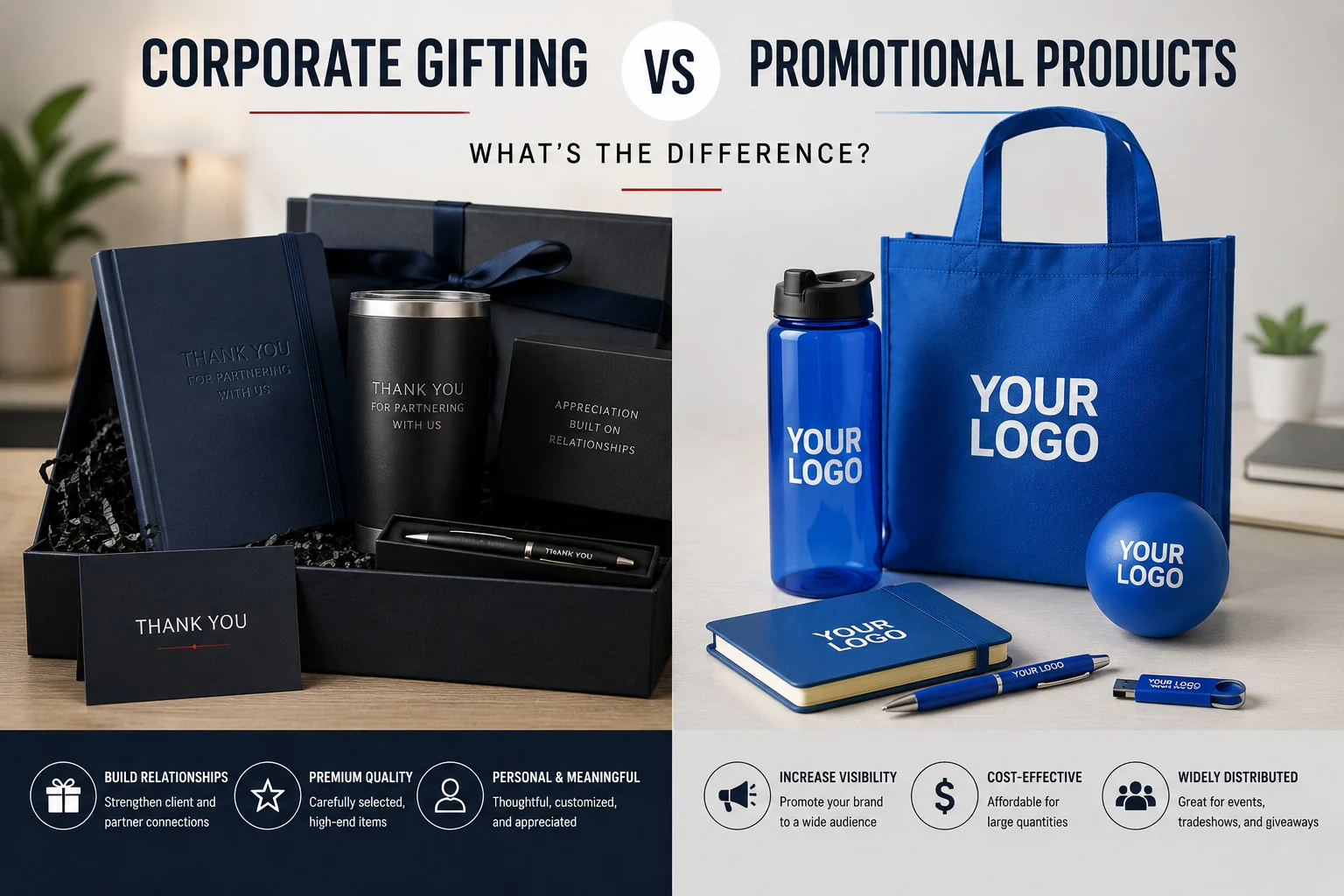
The two terms are used interchangeably, and the distinction sounds like semantics until you watch a budget get spent on the wrong one. They are bought for opposite reasons, judged by different people, and succeed on different terms.
The short version
A promotional product is bought to be seen. Its job is impressions: how many people encounter your brand, how often, and for how long. Success is reach.
A corporate gift is bought to be felt. Its job is a relationship: to acknowledge someone specific, at a specific moment, in a way they register as considered. Success is the recipient's reaction.
Almost every other difference follows from that one.
What changes in practice
Volume and unit cost. Promotional products are high volume and low unit cost, because reach is the metric. Gifts are low volume and higher unit cost, because one person's impression of a single object is the metric.
Branding. On a promotional product the logo is the point, and it is applied prominently. On a gift the logo is a signature — an engraving, a deboss, a woven label. A gift that shouts is read as advertising, and that is precisely the effect a gift is meant to avoid.
Packaging. Promotional products arrive in a carton because the item is the message. Gifts arrive in packaging because the unboxing is the message. This is the single biggest visible difference and the one most often skipped.
Selection. Promotional products are chosen for broad appeal — something that works for anyone who walks past a booth. Gifts are chosen for a known audience, and can afford to be specific because you know who is receiving them.
Measurement. Promotional products are measured on impressions and cost per impression. Gifts are measured on response, meetings, retention — the things covered in measuring the impact of corporate gifting.
When each is the right call
Choose promotional products when the audience is large, largely unknown, and the goal is familiarity — trade show booths, conference bags, sponsorships, community events, anything where you cannot name the recipients in advance. Trade show giveaways and bulk merchandise sit here.
Choose corporate gifting when the audience is specific and the relationship has value — clients, executives, partners, employees at a milestone. Corporate gifting and custom swag boxes sit here.
The expensive mistake in each direction
Buying gifts at promotional scale is the common one: a genuinely nice item, ordered for everybody, without packaging, without a note. It costs gift money and lands as a giveaway, because nothing about the delivery signaled otherwise.
The opposite happens too — a promotional item chosen on unit price and handed to someone whose business you want. A branded pen given to a decision maker is worse than nothing, because it prices the relationship.
Where the line genuinely blurs
Employee merchandise sits between them, and the useful test is whether it is issued or given. Kit that people need to do their job — uniform, safety wear, event apparel — behaves like a promotional product and should be specified and bought that way. Something marking a start date, a promotion or an anniversary is a gift, and should be packaged and presented as one. Same company, same budget line, two different jobs, and the packaging is usually what decides which one the recipient thinks it was.
If you are not sure which side of the line your project falls on, describe the audience and the occasion when you ask for a quote — that is enough to place it.