
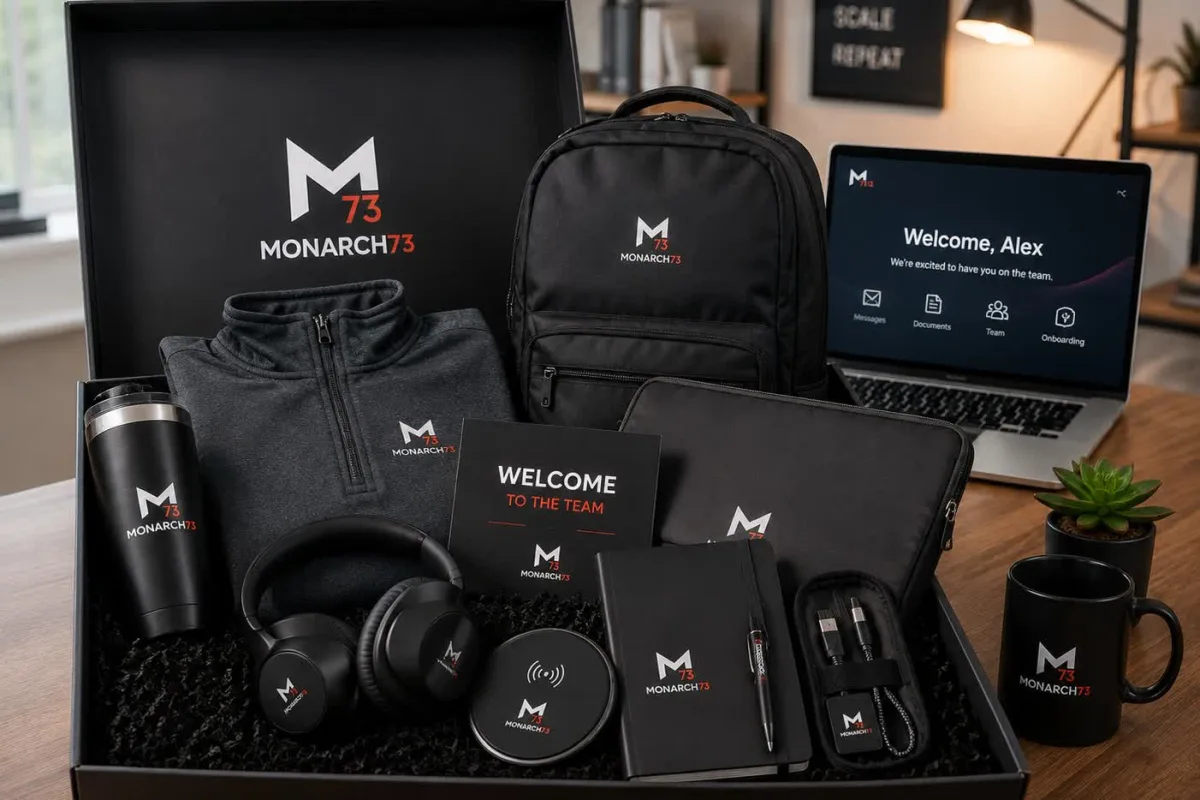
The swag itself is the easy part. What makes a remote program hard is that there is nowhere to send a pallet. Six hundred employees means six hundred addresses, six hundred labels and six hundred tracking numbers, and somebody has to own that.
Most companies discover this after ordering.
Decide who holds the addresses
This is the first real decision and it is usually made by accident. Either your People team maintains a spreadsheet of names, addresses and sizes — which goes stale immediately and is a privacy question nobody asked — or the employee enters their own details when they order.
The second is more accurate and removes the task. It also means somebody who moved house does not receive a hoodie at their old flat.
Hiring is continuous, so fulfillment has to be
Quarterly batches do not fit continuous hiring. A person who starts in week two of the quarter waits ten weeks for the thing meant to welcome them, by which point it welcomes nobody.
Producing once, holding stock and releasing kits against start dates is what makes day-one delivery possible. It is also cheaper than four short runs.
Budget for shipping honestly
Individual fulfillment costs more per recipient than a bulk delivery, and international shipping costs more again and may carry duties. That is not a reason to avoid it; it is a reason to include it in the number at the start, because it is the line that surprises people at approval.
Let people choose
Sizes, and ideally the item. A credit against an approved range gets you a hoodie somebody wears instead of a hoodie that fits nobody. It also removes the size spreadsheet permanently.
Spend on fewer, better things
Remote employees have limited desk space and no company office to fill. One good jacket beats five branded objects, and it is the one that gets worn on a call.
We run merchandise programs for distributed teams, and branded eStores covers letting employees order for themselves.