
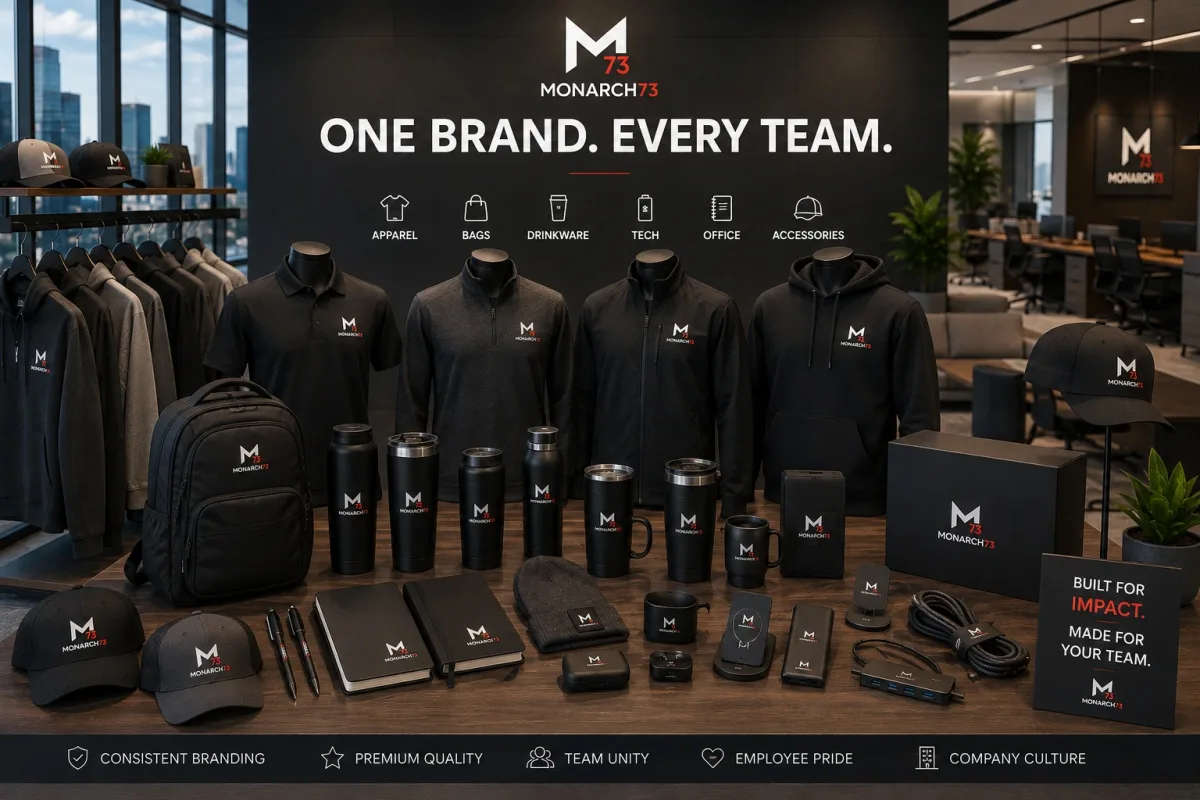
Most companies do not have an employee merchandise program. They have a recurring project that gets rebuilt from scratch whenever somebody needs something, usually under time pressure, usually by a person whose job it is not.
Name the moments first
Onboarding, milestones, recognition, all-hands, office openings, leaving gifts. Listing them turns an open-ended budget question into a countable one, and most of these moments are forecastable from your hiring plan.
Decide the range once
A defined range — a few apparel pieces, drinkware, a bag, an accessory — approved once and reused across every moment. This is what stops each occasion becoming a fresh sourcing exercise, and it is where most of the time saving lives.
Buy the year, not the occasion
One production run at annual volume beats four short runs on price, on consistency and on lead time. It requires holding stock somewhere that is not an office, which is the trade.
Separate approval from ordering
Approve the range centrally; let teams order from it directly. A single ordering desk becomes a queue, and a queue is what people route around.
Solve sizing structurally
Any program involving apparel eventually drowns in a size spreadsheet. Letting people choose their own size at the point of ordering removes the task permanently and is more accurate.
Make it reportable
Orders associated with the team that placed them means the program can be defended at budget time. Without it, merchandise spend is a lump nobody can explain.
Start smaller than you think
A tight range, well stocked, used for two or three moments beats a comprehensive catalog that is half out of stock by March.
Employee swag covers the program, and branded eStores covers letting teams order themselves.