
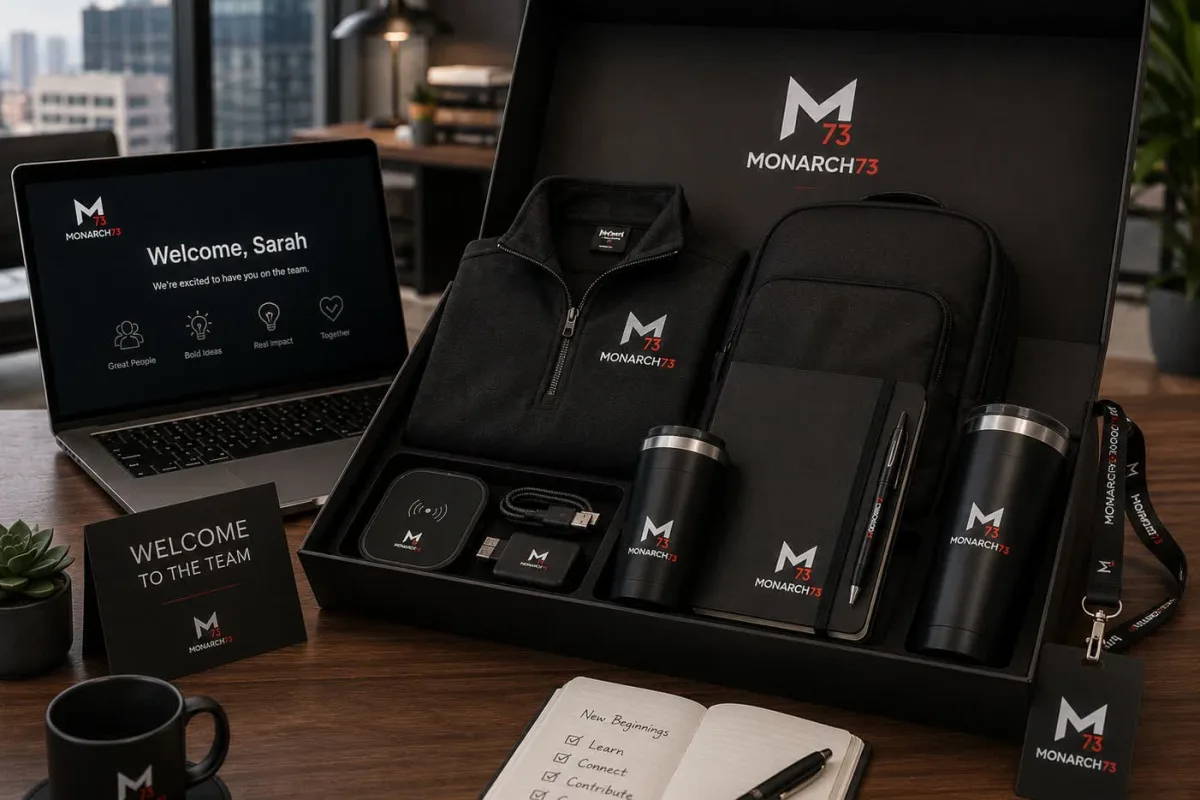
Welcome kits are assembled under a deadline by someone with other responsibilities, which is why they tend to contain five acceptable things rather than two good ones. The result is a box that produces a photograph on day one and nothing afterwards.
A better test: what will still be in use in six months?
The three that reliably survive
One good piece of outerwear. A fleece or quarter-zip is worn in public, kept across jobs, and carries more goodwill than everything else combined. It is also the item where quality is most obvious.
Something used daily on the desk. A proper bottle, a notebook people want to write in, a charging accessory. Small, used constantly.
A bag. Backpacks are expensive and disproportionately kept. If the budget only stretches to one substantial item, this and the outerwear are the candidates.
What to leave out
Anything printed with a year. Anything that duplicates what the company already issues. Anything where the logo is the largest element — people wear a good jacket with a small mark and never wear a mediocre one with a big one.
Sizing is the operational problem
Apparel means sizes, and collecting them by email is where these programs quietly break. Let the employee choose their own size and enter their own address. It is more accurate and it removes the task.
Write the card
The cheapest item in the box is usually the one people keep. A card that names the team and the role, rather than repeating the company values, does something the merchandise cannot.
Plan the second order before the first
Hiring continues. A kit with a twelve-week lead time and a high minimum is not a program; it is an event you will run out of. Ask what the reorder looks like at the same time you ask what the first run costs.
We assemble and ship employee kits, and kitting and fulfillment covers building to a specification and shipping individually.